
 Movie
Movie 11 hours ago
11
11 hours ago
11 Mark SavageMusic correspondent

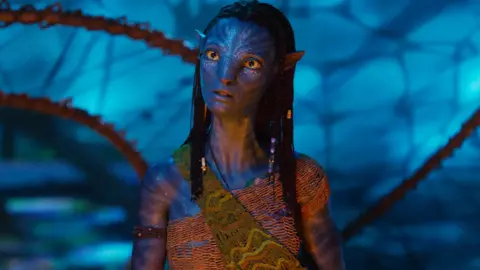 20th Century Studios
Avatar: Fire and Ash is predicted to be one of the year's highest-grossing movies
It's no secret the Avatar films are a gigantic technical feat - pushing the boundaries of cinematography, animation and performance capture.
But you may not be aware that the same applies to the music.
Composer Simon Franglen says work on the third instalment, Avatar: Fire and Ash, took an epic seven years to complete.
Along the way, he wrote 1,907 pages of orchestral score; and even invented new instruments for the residents of the alien planet Pandora to play.
And, with director James Cameron tinkering with the edit until the very last minute, the British musician only finished his final musical cue five days before the film was printed and delivered.
In total, Avatar contains "four times as much" music as a standard Hollywood film, says Franglen, with almost the entirety of its 195-minute running time requiring music.
"But I got 10 minutes off for good behaviour," he laughs.
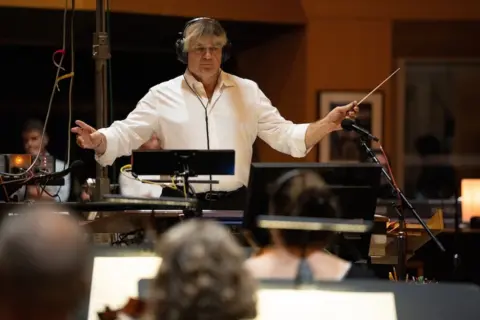 20th Century Studios
Simon Franglen spent seven years working on the score, with the bulk of the work taking place from 2023-25
Fire and Ash is the third instalment in the record-breaking series, continuing the saga of the blue Na'vi population, who are protecting their planet from human invaders, intent on stripping its natural resources.
The new film, released on 19 December, takes audiences back to the astonishingly vivid landscapes of Pandora, but it also sends them on a visceral emotional journey.
At the start of the film, the two main characters Jake Sully (Sam Worthington) and Neytiri (Zoe Saldana) are mourning the death of their teenage son, Neteyam.
Unable to see eye-to-eye, the grief threatens to tear the couple apart.
Franglen was tasked with creating a score that could reflect the depth of their despair.
"I wanted to make sure that you felt that sense of distance that was growing between them," he says.
"So what I would do is, I would take two lines [of music] and I'd have them moving apart, or I would make them go wrong, so that they felt austere and cold and disconnected."
"Grief is not something that is ever addressed in these sorts of films," he continues, "but for any family, the loss of a child is the worst thing you can go through.
"Musically, the important stuff is often the quiet moments."
A hoedown on a galleon
By contrast, when Franglen composed the music for the Wind Traders - a nomadic clan of salesmen, who travel by airship - he could let his imagination run wild.
Their swashbuckling themes are inspired by the action movies of the 1930s and 40s, but they also feature brand new instruments, unique to Pandora.
"When we meet the wind traders [they're having] a hoedown on their enormous Galleon," says Franglen.
"The problem was that, if you are having a Pandoran party, what do they play? I can't give them guitar, bass and drums. I can't give them a banjo.
"You have to have a real instrument that would be designed for three metre-tall, blue people with four fingers.
"And because Avatar is not animation, when there are instruments on screen, you have to have the real thing," he says, referring to Cameron's rule that everything on screen has to be rooted in reality, even though the film's imagery is largely computer-generated.
"So I sketched out some instruments, and gave them to the art department, who made these beautiful designs."
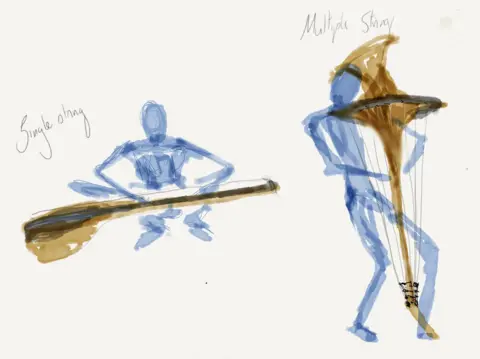 20th Century Studios
Franglen sketches were turned into actual, playable instruments
Franglen's creations included a long-necked lute, similar to a Turkish saz, with strings that represent the rigging of the Wind Traders' ship.
A percussion instrument was also designed, with the drum head using the same material as the vessel's sails.
The art department's renders were then given to prop master Brad Elliott, who built the instruments on a 3D printers, and the actors played them for real on set.
For now, however, these inventions have no official name.
"They are currently called 'the stringy things' and 'the drummy things'," laughs Franglen.
"I'm sure there's a better name. Somebody said we should have a competition."
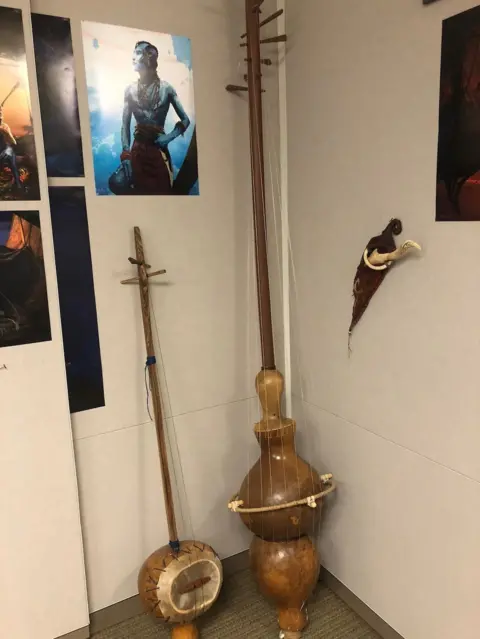 20th Century Studios
Franglen says his new instruments could be produced commercially if there is enough demand from fans
Franglen's musical career started when he was just 13 years old- he wrote a letter to the BBC asking how someone would go about becoming a record producer.
Mistakenly assuming he was asking about radio production, the corporation advised him to study electronics - leading him to a course at Manchester University in the early 1980s.
He arrived just as the Hacienda Club opened ("I was member 347") and spent his free time booking bands for the college's concert venue.
"I remember booking Tears for Fears and 11 people came," he says.
After graduating, he was hired to work as a synth programmer, and was introduced to Trevor Horn - who set him to work on pivotal 80s albums by Yes and Frankie Goes To Hollywood.
Eventually, he decided to try his luck in America where, "after six months of doing almost nothing", he became an in-demand session musician and programmer.
Credits started to rack up on hits like Toni Braxton's Unbreak My Heart, All 4 One's I Swear and Whitney Houston's I Have Nothing; and he eventually found himself programming drums for Michael Jackson's HIStory album.
"The pressure was to make it great," he says. "To have that sense of groove, what we call, 'the pocket'.
"And a big part of my career is that I had a good pocket. I understood where things should feel and how they should hit. And that is as important with film scores as it is when you're making a Michael Jackson record."
Franglen's first experience of film scoring came when Bond composer John Barry asked him to assist on Kevin Costner's Oscar-winning Dances With Wolves. He was later hired to do the "dark and nasty stuff" on David Fincher's Se7en.
"My job was to provide the dystopian edge that that score has. So I would take squealing brakes, make samples of them, and then play all the violin lines with squealing brakes underneath.
"There was a lot of experimental stuff, which was incredibly fun."
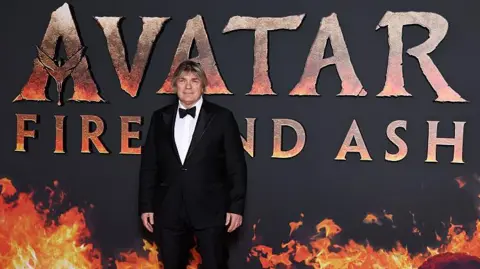 Getty Images
Franglen says he'll work on some smaller projects before returning to the Avatar universe
Franglen first met Avatar director James Cameron after being hired by legendary film composer James Horner, to work "on a film he had no money for".
The film was Titanic - a notorious white elephant, dismissed as a vanity project, and predicted to bring about the collapse of film studios Fox and Paramount.
The composer had seen the headlines, but when Cameron showed him the scene where the Titanic broke in half and started to sink, he realised the press had got it wrong.
"It was just astonishing, in comparison to anything you'd seen before. I knew it was special."
Even so, there was no budget left for the music, Franglen had to borrow equipment and instruments from the manufacturers, and the majority of the score was recorded on synthesizers in a rented apartment.
"Part of the reason that Titanic sounds the way that it does, is because there wasn't enough money for [an] orchestra everywhere," he says.
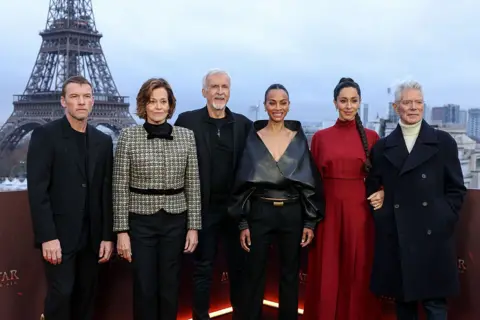 Getty Images
The cast posed with director James Cameron ahead of Avatar's European premiere earlier this week (L-R): Sam Worthington, Sigourney Weaver, James Cameron, Zoe Saldana, Oona Castilla Chaplin and Stephen Lang
The opposite is true on Avatar.
"Jim [Cameron] still believes that the good things take time. And as a composer, having that ability to refine and to make something special is something that is rare these days."
The director also went to great lengths to ensure his latest film is free from artificial intelligence.
"He very specifically asked me, 'So, we're not using any AI? We're not putting any real musicians out of work'," Franglen recalls.
"It's fair to say that if you gave a lot of film producers the option to save money, they would take that option.
"Jim is in a situation where he will not compromise, and that's as important when it comes to the music as it is to the live performances of the actors."
As the film prepares to open, Franglen is celebrating a Golden Globe nomination for the theme song, Dream As One, sung by Miley Cyrus.
But he's also thinking about what comes next. Cameron has already completed the scripts for Avatar Four and Five; scheduled to come out in 2029 and 2031.
"Four is… I think it's astonishing," says Franglen. "It goes into whole new territories, and I love it."
Initial footage has already been shot, but Cameron says completing the film will depend on the box office performance of Fire and Ash.
"I really hope that we break even, so that we can make it," says Franglen.
"I think they said after Avatar Two that the break even point was $1.4 billion (£1 billion).
"I have no way of knowing, but I presume that it's a similar number for this one.
"So if the audience tells us that they want an Avatar Four, I'm very much looking forward to doing that."
![Presidents Day Weekend Car Sales [2021 Edition]](https://www.findthebestcarprice.com/wp-content/uploads/Presidents-Day-Weekend-car-sales.jpg "Presidents Day Weekend Car Sales [2021 Edition]")




 English (United States)