
 Movie
Movie 4 hours ago
9
4 hours ago
9 Helen BriggsEnvironment correspondent

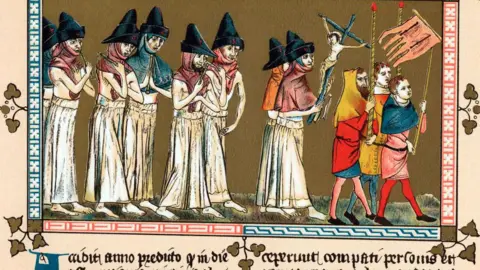 Getty Images
The Black Death fundamentally altered medieval society
A volcanic eruption around 1345 may have set off a chain reaction that unleashed Europe's deadliest pandemic the Black Death, scientists say.
Clues preserved in tree rings suggest the eruption triggered a climate shock and led to a string of events that brought the disease to medieval Europe.
Under this scenario, the ash and gases from a volcanic eruption caused extreme drops in temperature and led to poor harvests.
To avert famine, populous Italian city states were forced to import grain from areas around the Black Sea - bringing plague-carrying fleas that carried the disease to Europe as well.
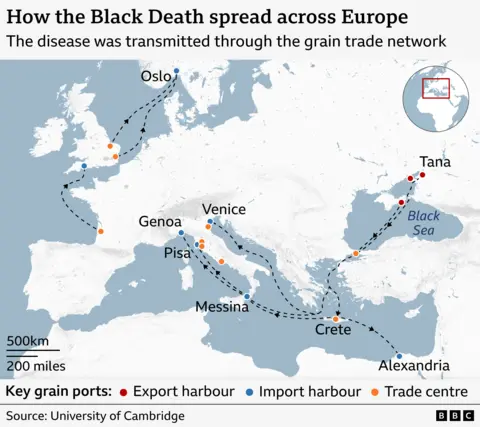
This "perfect storm" of a climate shock, famine and trade offers a reminder of how diseases can emerge and spread in a globalised and warmer world, according to experts.
"Although the coincidence of factors that contributed to the Black Death seems rare, the probability of zoonotic diseases emerging under climate change and translating into pandemics is likely to increase in a globalised world," said Dr Ulf Büntgen of the University of Cambridge.
He added: "This is especially relevant given our recent experiences with Covid-19."
 Credit: Ulf Büntgen
Tree rings from the Spanish Pyrenees point to unusually cold summers in 1345, 1346 and 1347
The Black Death swept across Europe in 1348-49, killing up to half of the population.
The disease was caused by a bacterium known as Yersinia pestis spread by wild rodents, such as rats, and fleas.
The outbreak is believed to have started in Central Asia, moving around the world through trade.
But the precise sequence of events that brought the disease to Europe - killing millions of people – has been pored over by scholars.
Now researchers from the University of Cambridge and the Leibniz Institute for the History and Culture of Eastern Europe (GWZO) in Leipzig have filled in a missing part of the puzzle.
They used clues from tree rings and ice cores to examine climatic conditions at the time of the Black Death.
Their evidence suggests that volcanic activity around 1345 caused temperatures to drop sharply over consecutive years because of the release of volcanic ash and gases which blocked out some sunlight.
This in turn caused crops to fail across the Mediterranean region. To avoid starvation, Italian city states traded with grain producers around the Black Sea, unwittingly enabling the deadly bacterium to gain a foothold in Europe.
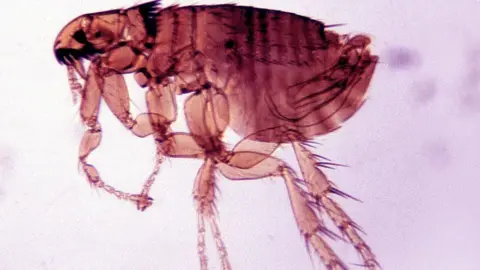 Getty
Getty
Fleas spread the plague from infected rats to humans
Dr Martin Bauch, a historian of medieval climate and epidemiology from GWZO, said climatic events met a "complicated system of food security" in what amounted to a "perfect storm".
"For more than a century, these powerful Italian city states had established long-distance trade routes across the Mediterranean and the Black Sea, allowing them to activate a highly efficient system to prevent starvation," he said. "But ultimately, these would inadvertently lead to a far bigger catastrophe."
The findings are reported in the journal Communications Earth & Environment.



![Presidents Day Weekend Car Sales [2021 Edition]](https://www.findthebestcarprice.com/wp-content/uploads/Presidents-Day-Weekend-car-sales.jpg "Presidents Day Weekend Car Sales [2021 Edition]")




 English (United States)