
 Movie
Movie 3 hours ago
7
3 hours ago
7 Faarea MasudBusiness reporter

 MedExpress
MedExpress's social media advert was banned for targeting new mums
An advert which targeted weight-loss injections at new mums has been banned by the Advertising Standards Authority (ASA).
MedExpress's social media post used a harmful gender stereotype which suggested women should prioritise losing weight soon after giving birth, the ASA said.
The ad was banned along with two by SkinnyJab and CheqUp for irresponsibly exploiting insecurities around body image. All three firms have removed the ads.
It is illegal to advertise prescription-only weight loss drugs to the public. The ASA said the "scale of the problem" was worse now as people feel extra pressure to lose weight as part of New Year resolutions.
MedExpress's video advert on Instagram featured a woman taking a selfie in the mirror with text reading: "I wish I knew sooner that I could lose post-baby weight with a medicated weight loss treatment from MedExpress".
The ASA said it understood the weight-loss medication "carried safety warnings for people who were breast-feeding". It said the advert was "irresponsible" as it "perpetuated pressure for them to conform to body image stereotypes".
MedExpress told the BBC that as a result of the ASA ban, it had "strengthened our internal sign-off processes, introduced additional sensitivity checks, and enhanced advertising governance across all conditions and categories we serve."
Stigma associated with being a certain size
All three adverts appeared on social media platforms including Facebook and TikTok where online sellers seek to gain space in the hugely popular weight-loss jab market which is now worth billions of dollars globally.
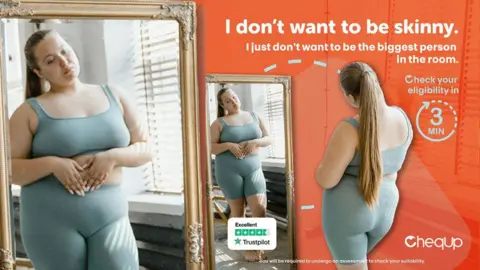
CheqUp's Facebook advert featured a woman looking in the mirror with the quote: "I don't want to be skinny, I just don't want to be the biggest person in the room".
Complaints to the ASA said this suggested a stigma associated with being a certain size.
"Furthermore, by showing the model looking into a mirror, the ad emphasised physical appearance rather than health," the ASA said.
 CheqUp
The ASA said this model wasn't necessarily unhealthily overweight
The firm had argued that the advert's text focused on the model not wanting to be "skinny", but rather wanting to get to a healthy weight - but the advertising watchdog disagreed, saying the model was not necessarily unhealthily overweight in the first place.
CheqUp sells prescription-only weight-loss jabs as well as over-the-counter ones, and says it has a three-minute online consultation with a healthcare professional that tests buyers for suitability.
Weight-loss jabs have grown in popularity
A spokesperson for the company said it moved quickly to comply with the ASA, had removed the advert and was fully committed to taking an "ethical approach" to advertising in the health and wellness space.
Weight-loss jabs were originally developed to help patients lose weight to control their diabetes, but soon began to be used for cosmetic purposes. They gained further popularity as celebrities such as Adele, Rebel Wilson, Sharon Osbourne and Tesla-owner Elon Musk were open about the rapid weight loss they've experienced using the jabs.
Meanwhile, SkinnyJab's video of its founder talking about weight loss injections was not an educational and informative resource, as the firm had argued, but was in fact an advert and subject to the ASA's regulations. It said the firm could not promote prescription-only medicines to the public in future by, for example, using the term "SkinnyJab" in marketing material.
The firm said it had removed the advert and was conducting a full review of its branding, terminology and communications.





![Presidents Day Weekend Car Sales [2021 Edition]](https://www.findthebestcarprice.com/wp-content/uploads/Presidents-Day-Weekend-car-sales.jpg "Presidents Day Weekend Car Sales [2021 Edition]")




 English (United States)